深度学习mindspore ----win10下mindspore 安装验证
·
win10 , cpu的情况下安装的mindspore。目前因为环境问题,所以,很少程序支持。下面我给出程序,验证过程和结果。
参考资料: https://www.mindspore.cn/tutorial/zh-CN/master/quick_start/quick_start.html
程序案例路径: https://gitee.com/mindspore/docs/blob/master/tutorials/tutorial_code/lenet.py
程序我稍微做了点改动。
import os
import urllib.request
from urllib.parse import urlparse
import gzip
import argparse
import mindspore.dataset as ds
import mindspore.nn as nn
from mindspore import context
from mindspore.train.serialization import load_checkpoint, load_param_into_net
from mindspore.train.callback import ModelCheckpoint, CheckpointConfig, LossMonitor
from mindspore.train import Model
from mindspore.common.initializer import TruncatedNormal
import mindspore.dataset.transforms.vision.c_transforms as CV
import mindspore.dataset.transforms.c_transforms as C
from mindspore.dataset.transforms.vision import Inter
from mindspore.nn.metrics import Accuracy
from mindspore.common import dtype as mstype
from mindspore.nn.loss import SoftmaxCrossEntropyWithLogits


def unzipfile(gzip_path):
    """unzip dataset file
    Args:
        gzip_path: dataset file path
    """
    open_file = open(gzip_path.replace('.gz',''), 'wb')
    gz_file = gzip.GzipFile(gzip_path)
    open_file.write(gz_file.read())
    gz_file.close()


def download_dataset():
    """Download the dataset from http://yann.lecun.com/exdb/mnist/."""
    print("******Downloading the MNIST dataset******")
    train_path = "./MNIST_Data/train/"
    test_path = "./MNIST_Data/test/"
    train_path_check = os.path.exists(train_path)
    test_path_check = os.path.exists(test_path)
    if train_path_check == False and test_path_check ==False:
        os.makedirs(train_path)
        os.makedirs(test_path)
    train_url = {"http://yann.lecun.com/exdb/mnist/train-images-idx3-ubyte.gz", "http://yann.lecun.com/exdb/mnist/train-labels-idx1-ubyte.gz"}
    test_url = {"http://yann.lecun.com/exdb/mnist/t10k-images-idx3-ubyte.gz", "http://yann.lecun.com/exdb/mnist/t10k-labels-idx1-ubyte.gz"}
    for url in train_url:
        url_parse = urlparse(url)
        # split the file name from url
        file_name = os.path.join(train_path,url_parse.path.split('/')[-1])
        if not os.path.exists(file_name.replace('.gz','')):
            file = urllib.request.urlretrieve(url, file_name)
            unzipfile(file_name)
            os.remove(file_name)
    for url in test_url:
        url_parse = urlparse(url)
        # split the file name from url
        file_name = os.path.join(test_path,url_parse.path.split('/')[-1])
        if not os.path.exists(file_name.replace('.gz','')):
            file = urllib.request.urlretrieve(url, file_name)
            unzipfile(file_name)
            os.remove(file_name)


def create_dataset(data_path, batch_size=32, repeat_size=1,
                   num_parallel_workers=1):
    """ create dataset for train or test
    Args:
        data_path: Data path
        batch_size: The number of data records in each group
        repeat_size: The number of replicated data records
        num_parallel_workers: The number of parallel workers
    """
    # define dataset
    mnist_ds = ds.MnistDataset(data_path)

    # define operation parameters
    resize_height, resize_width = 32, 32
    rescale = 1.0 / 255.0
    shift = 0.0
    rescale_nml = 1 / 0.3081
    shift_nml = -1 * 0.1307 / 0.3081

    # define map operations
    resize_op = CV.Resize((resize_height, resize_width), interpolation=Inter.LINEAR)  # Resize images to (32, 32)
    rescale_nml_op = CV.Rescale(rescale_nml, shift_nml) # normalize images
    rescale_op = CV.Rescale(rescale, shift) # rescale images
    hwc2chw_op = CV.HWC2CHW() # change shape from (height, width, channel) to (channel, height, width) to fit network.
    type_cast_op = C.TypeCast(mstype.int32) # change data type of label to int32 to fit network

    # apply map operations on images
    mnist_ds = mnist_ds.map(input_columns="label", operations=type_cast_op, num_parallel_workers=num_parallel_workers)
    mnist_ds = mnist_ds.map(input_columns="image", operations=resize_op, num_parallel_workers=num_parallel_workers)
    mnist_ds = mnist_ds.map(input_columns="image", operations=rescale_op, num_parallel_workers=num_parallel_workers)
    mnist_ds = mnist_ds.map(input_columns="image", operations=rescale_nml_op, num_parallel_workers=num_parallel_workers)
    mnist_ds = mnist_ds.map(input_columns="image", operations=hwc2chw_op, num_parallel_workers=num_parallel_workers)

    # apply DatasetOps
    buffer_size = 10000
    mnist_ds = mnist_ds.shuffle(buffer_size=buffer_size)  # 10000 as in LeNet train script
    mnist_ds = mnist_ds.batch(batch_size, drop_remainder=True)
    mnist_ds = mnist_ds.repeat(repeat_size)

    return mnist_ds


def conv(in_channels, out_channels, kernel_size, stride=1, padding=0):
    """Conv layer weight initial."""
    weight = weight_variable()
    return nn.Conv2d(in_channels, out_channels,
                     kernel_size=kernel_size, stride=stride, padding=padding,
                     weight_init=weight, has_bias=False, pad_mode="valid")


def fc_with_initialize(input_channels, out_channels):
    """Fc layer weight initial."""
    weight = weight_variable()
    bias = weight_variable()
    return nn.Dense(input_channels, out_channels, weight, bias)


def weight_variable():
    """Weight initial."""
    return TruncatedNormal(0.02)


class LeNet5(nn.Cell):
    """Lenet network structure."""
    # define the operator required
    def __init__(self):
        super(LeNet5, self).__init__()
        self.conv1 = conv(1, 6, 5)
        self.conv2 = conv(6, 16, 5)
        self.fc1 = fc_with_initialize(16 * 5 * 5, 120)
        self.fc2 = fc_with_initialize(120, 84)
        self.fc3 = fc_with_initialize(84, 10)
        self.relu = nn.ReLU()
        self.max_pool2d = nn.MaxPool2d(kernel_size=2, stride=2)
        self.flatten = nn.Flatten()

    # use the preceding operators to construct networks
    def construct(self, x):
        x = self.conv1(x)
        x = self.relu(x)
        x = self.max_pool2d(x)
        x = self.conv2(x)
        x = self.relu(x)
        x = self.max_pool2d(x)
        x = self.flatten(x)
        x = self.fc1(x)
        x = self.relu(x)
        x = self.fc2(x)
        x = self.relu(x)
        x = self.fc3(x)
        return x


def train_net(args, model, epoch_size, mnist_path, repeat_size, ckpoint_cb):
    """Define the training method."""
    print("============== Starting Training ==============")
    # load training dataset
    ds_train = create_dataset(os.path.join(mnist_path, "train"), 32, repeat_size)
    model.train(epoch_size, ds_train, callbacks=[ckpoint_cb, LossMonitor()], dataset_sink_mode=False)


def test_net(args, network, model, mnist_path):
    """Define the evaluation method."""
    print("============== Starting Testing ==============")
    # load the saved model for evaluation
    param_dict = load_checkpoint("checkpoint_lenet-1_1875.ckpt")
    # load parameter to the network
    load_param_into_net(network, param_dict)
    # load testing dataset
    ds_eval = create_dataset(os.path.join(mnist_path, "test"))
    acc = model.eval(ds_eval, dataset_sink_mode=False)
    print("============== Accuracy:{} ==============".format(acc))


if __name__ == "__main__":
    parser = argparse.ArgumentParser(description='MindSpore LeNet Example')
    parser.add_argument('--device_target', type=str, default="CPU", choices=['Ascend', 'GPU', 'CPU'],
                        help='device where the code will be implemented (default: CPU)')
    args = parser.parse_args()
    context.set_context(mode=context.GRAPH_MODE, device_target=args.device_target,
                        enable_mem_reuse=False)
    # download mnist dataset
    # download_dataset()
    # learning rate setting
    lr = 0.01
    momentum = 0.9
    epoch_size = 1
    mnist_path = "./MNIST_Data"
    # define the loss function
    net_loss = SoftmaxCrossEntropyWithLogits(is_grad=False, sparse=True, reduction='mean')
    repeat_size = epoch_size
    # create the network
    network = LeNet5()
    # define the optimizer
    net_opt = nn.Momentum(network.trainable_params(), lr, momentum)
    config_ck = CheckpointConfig(save_checkpoint_steps=1875, keep_checkpoint_max=10)
    # save the network model and parameters for subsequence fine-tuning
    ckpoint_cb = ModelCheckpoint(prefix="checkpoint_lenet", config=config_ck)
    # group layers into an object with training and evaluation features
    model = Model(network, net_loss, net_opt, metrics={"Accuracy": Accuracy()})

    train_net(args, model, epoch_size, mnist_path, repeat_size, ckpoint_cb)
    test_net(args, network, model, mnist_path)
大部分都是官方内容。
注意: 官方文件的内容,下载数据集部分不能错。 配置路径等,剩下所有的设置都不需要,只需要直接运行。
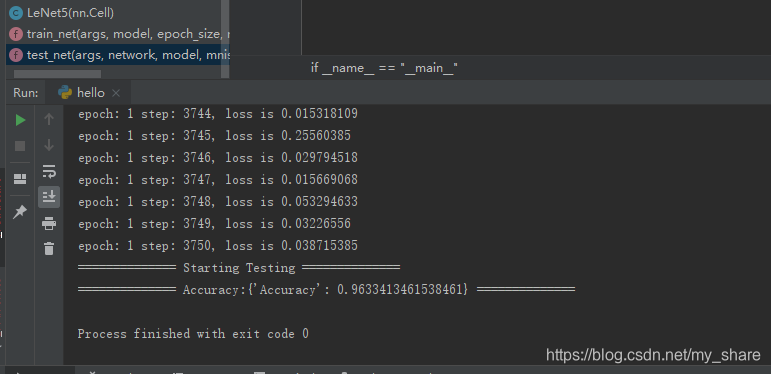
运行成功。
-------------------------
你好,我是毛华望。 如果你有python基础的话,或者tensorflow基础的话,其实随意一点都可以的。问题不大。如果没有的话,就要把注意点注意一下了。

昇腾计算产业是基于昇腾系列(HUAWEI Ascend)处理器和基础软件构建的全栈 AI计算基础设施、行业应用及服务,https://devpress.csdn.net/organization/setting/general/146749包括昇腾系列处理器、系列硬件、CANN、AI计算框架、应用使能、开发工具链、管理运维工具、行业应用及服务等全产业链
更多推荐

 0
0 0
0- 0


 已为社区贡献6条内容

所有评论(0)