【vLLM-模型特性适配】vllm-ascend开发之Rope适配
摘要:本文详细介绍了旋转位置编码(RoPE)的技术原理及其在VLLM框架中的实现。RoPE通过旋转矩阵为Transformer的查询和键向量注入位置信息,支持half和interleave两种计算模式。文章剖析了RoPE的核心计算逻辑,包括位置索引处理、向量拆分和旋转运算,并对比了不同实现方式。随后以Qwen3为例,展示了VLLM中RoPE的完整执行流程,包括初始化、缓存计算及多硬件后端适配机制。
作者:昇腾实战派
1. 背景及Rope结构介绍
RoPE(旋转位置编码)是一种用于Transformer模型的位置编码技术,其核心思想是通过旋转矩阵为查询(q)和键(k)向量注入绝对位置信息,从而在注意力计算中实现相对位置编码。
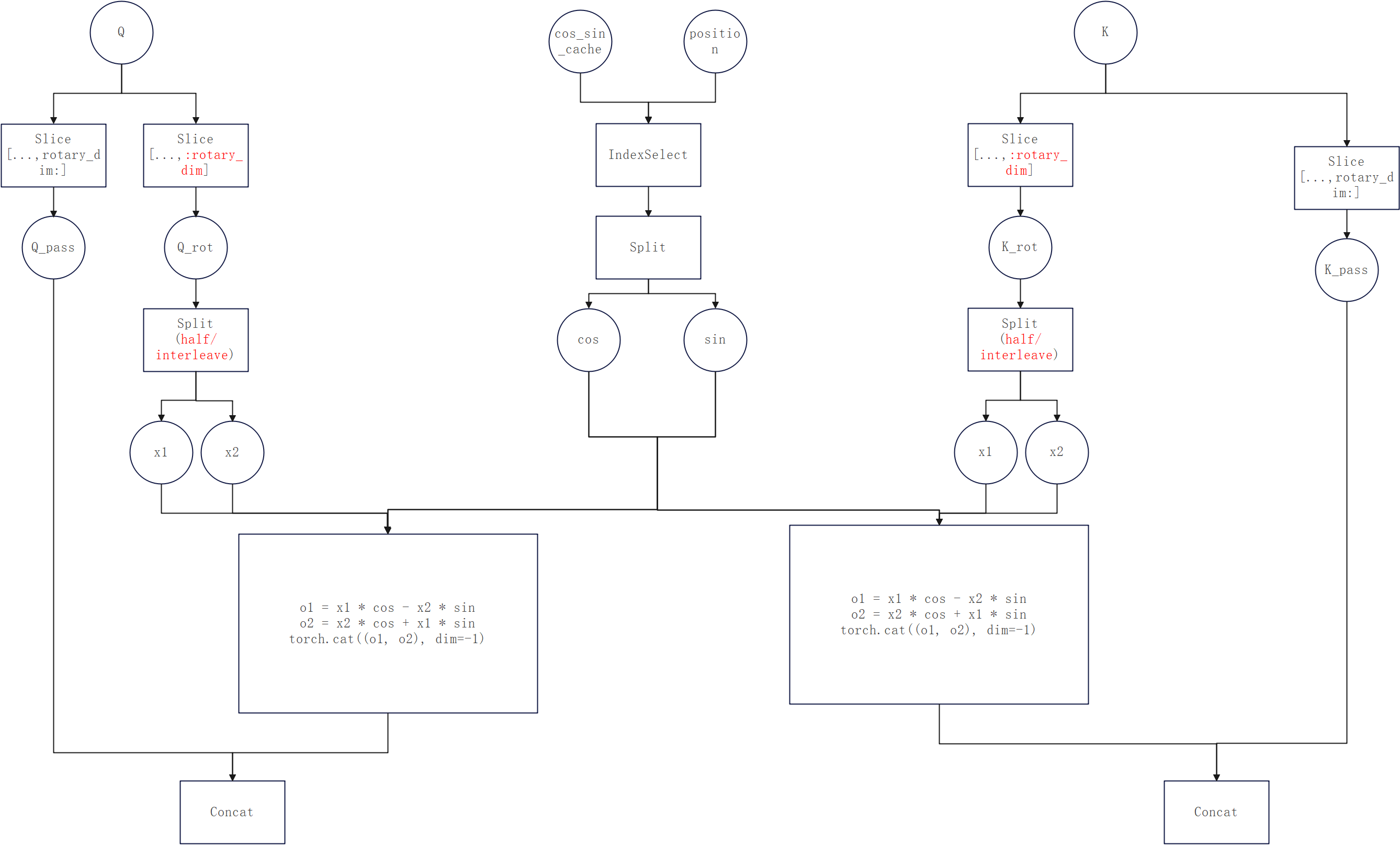
首先看一下常见的rope计算的逻辑:
-
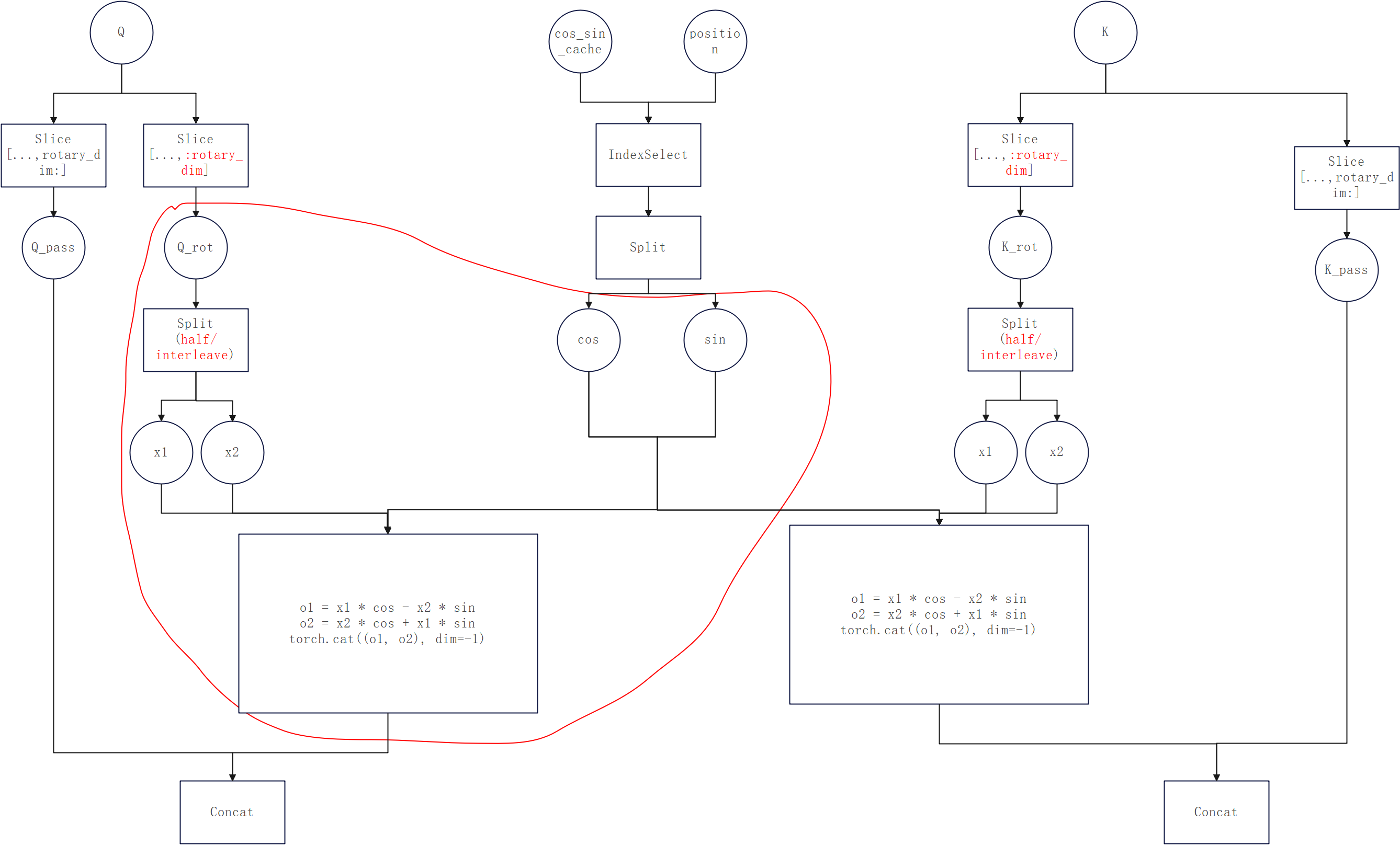
根据position_id的值从cos_sin_cache中取出对应的cos,和sin。
-
将Q/K在最后一维根据rotary_dim进行拆分。有些模型因为rotary_dim=head_size,所以就不需要这一步,如Qwen2/3。
-
将Q_rot/K_rot在最后一维拆成两份,注意这里有两种模式:half和interleave。
- half也就是gpt_neox style,直接在最后一维对半切:
x.reshape(bs, 2, head_num*head_size//2).chunk(2, dim=-2); - interleave也就是gptj style,是在最后一维交叉取值:
x.reshape(bs, head_num*head_size//2, 2).chunk(2, dim=-1)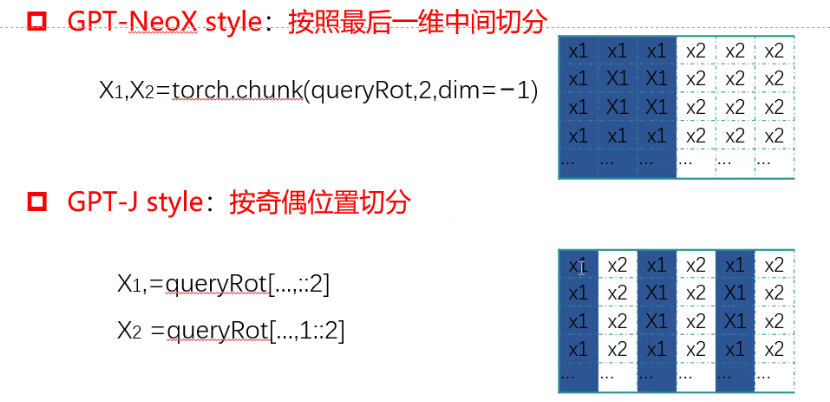
- half也就是gpt_neox style,直接在最后一维对半切:
-
以Q为例,这样我们就拿到了x1,x2,cos,sin,接下来就是rope的主要计算,不同模型在实现上有些差异:
# 实现1:
o1 = x1 * cos - x2 * sin
o2 = x2 * cos + x1 * sin
# half模式
q = torch.cat((o1, o2), dim=-1)
# interleave模式
q = torch.stack((o1, o2), dim=-1).flatten(-2)

# 实现2:
# 这一段可能在init中完成
cos = torch.cat((cos, cos), dim=-1)
sin = torch.cat((sin, sin), dim=-1)

def _rotate_neox(x: torch.Tensor) -> torch.Tensor:
    x1 = x[..., :x.shape[-1] // 2]
    x2 = x[..., x.shape[-1] // 2:]
    return torch.cat((-x2, x1), dim=-1)

def _rotate_gptj(x: torch.Tensor) -> torch.Tensor:
    x1 = x[..., ::2]
    x2 = x[..., 1::2]
    x = torch.stack((-x2, x1), dim=-1)
    return x.flatten(-2)

# half模式
q = q * cos + _rotate_neox(q) * sin
# interleave模式
q = q * cos + _rotate_gptj(q) * sin
- 最后需要把Q_pass/K_pass和Q_rot/K_pass再拼回来。
2. vllm中Rope的实现
VLLM的模型统一通过vllm.model_executor.layers.rotary_embedding中的get_rope方法,根据传入的参数来选择具体的RotaryEmbedding类。接下来以v.010.0的Qwen3为例简要说明执行流程:
- 模型的Attention init中调用get_rope获取rope对象:
class Qwen3Attention(nn.Module):
    def __init__(self, ...):
        ...
        self.rotary_emb = get_rope(
            self.head_dim,
            rotary_dim=self.head_dim,
            max_position=max_position,
            base=self.rope_theta,
            rope_scaling=rope_scaling,
        )
- get_rope根据config选择RotaryEmbedding类实例化:
def get_rope(...):
    ...
    if dual_chunk_attention_config is not None:
        extra_kwargs = {
            k: v
            for k, v in dual_chunk_attention_config.items()
            if k in ("chunk_size", "local_size")
        }
        rotary_emb = DualChunkRotaryEmbedding(head_size, rotary_dim,
                                              max_position, base,
                                              is_neox_style, dtype,
                                              **extra_kwargs)
    elif not rope_scaling:
        # Qwen3走的是这个
        rotary_emb = RotaryEmbedding(head_size, rotary_dim, max_position, base,
                                     is_neox_style, dtype)
    else:
        ...
- RotaryEmbedding的init中生成self.cos_sin_cache,forward中执行实际的rope计算:
class RotaryEmbedding(CustomOp):
    def __init__(...):
        super().__init__()
        self.head_size = head_size
        self.rotary_dim = rotary_dim
        self.max_position_embeddings = max_position_embeddings
        self.base = base
        self.is_neox_style = is_neox_style
        self.dtype = dtype

        # 此处生成最大序列长度的cos_sin_cache
        cache = self._compute_cos_sin_cache()
        cache = cache.to(dtype)
        self.cos_sin_cache: torch.Tensor
        # 注册为self.cos_sin_cache
        self.register_buffer("cos_sin_cache", cache, persistent=False)
        self.is_rocm_aiter_enabled = is_rocm_rotary_embedding_enabled()

    # 此处计算inv_freq
    def _compute_inv_freq(self, base: float) -> torch.Tensor:
        """Compute the inverse frequency."""
        # NOTE(woosuk): To exactly match the HF implementation, we need to
        # use CPU to compute the cache and then move it to GPU. However, we
        # create the cache on GPU for faster initialization. This may cause
        # a slight numerical difference between the HF implementation and ours.
        inv_freq = 1.0 / (base**(torch.arange(
            0, self.rotary_dim, 2, dtype=torch.float) / self.rotary_dim))
        return inv_freq

    # 此处根据最大长度计算cos和sin
    def _compute_cos_sin_cache(self) -> torch.Tensor:
        """Compute the cos and sin cache."""
        inv_freq = self._compute_inv_freq(self.base)
        t = torch.arange(self.max_position_embeddings, dtype=torch.float)

        # 注意部分模型(如gemma3)的非vllm实现中,这里会对freqs做repeat,对应上节1.4中实现2:
        # freqs = torch.cat((freqs, freqs), dim=-1)
        freqs = torch.einsum("i,j -> ij", t, inv_freq)
        cos = freqs.cos()
        sin = freqs.sin()
        cache = torch.cat((cos, sin), dim=-1)
        return cache

    def forward_native(...):
        ...

    def forward_cuda(...):
        ...

    def forward_xpu(...):
        ...

    def forward_hpu(...):
        ...

    def forward_neuron(...):
        ...
- 可以看到上面的RotaryEmbedding针对不同的硬件后端有多个forward方法,forward的选择逻辑在其基类CustomOp中实现,vllm-ascend是通过替换forward_oot方法来做的兼容:
class CustomOp(nn.Module):
    """
    Base class for custom ops.
    Dispatches the forward method to the appropriate backend.
    """

    def __init__(self):
        super().__init__()
        self._forward_method = self.dispatch_forward()

    def forward_oot(self, *args, **kwargs):
        # By default, we assume that OOT ops are compatible with the
        # PyTorch-native implementation.
        return self.forward_native(*args, **kwargs)

    def dispatch_forward(self):
        # NOTE(woosuk): Here we assume that vLLM was built for only one
        # specific backend. Currently, we do not support dynamic dispatching.
        compilation_config = get_current_vllm_config().compilation_config
        enabled = self.enabled()
        if enabled:
            compilation_config.enabled_custom_ops.update([self.__class__.name])
        else:
            compilation_config.disabled_custom_ops.update(
                [self.__class__.name])

        if not enabled:
            return self.forward_native

        if current_platform.is_rocm():
            return self.forward_hip
        elif current_platform.is_cpu():
            return self.forward_cpu
        elif current_platform.is_hpu():
            return self.forward_hpu
        elif current_platform.is_tpu():
            return self.forward_tpu
        elif current_platform.is_xpu():
            return self.forward_xpu
        elif current_platform.is_neuron():
            return self.forward_neuron
        elif current_platform.is_out_of_tree():
            return self.forward_oot
        else:
            return self.forward_cuda
3. vllm-ascend的实现
- 以v0.10.0rc1为例,vllm-ascend的rope实现在ops/rotary_embedding.py中,可以看到我们单独写了个rope_forward_oot方法并在最后替换了原生的forward_oot。所以通过vllm-ascend调用的RotaryEmbedding,最终都会走rope_forward_oot**:**
def rope_forward_oot(
    self,
    positions: torch.Tensor,
    query: torch.Tensor,
    key: torch.Tensor,
    offsets: Optional[torch.Tensor] = None,
    is_neox_style_override: Optional[bool] = None
) -> Tuple[torch.Tensor, torch.Tensor]:
    if get_ascend_config().torchair_graph_config.enabled:
        return self.forward_native(
            positions,
            query,
            key,
            offsets,
        )

    import torch_npu
    query_shape, key_shape = query.shape, key.shape
    if self.cos_sin_cache.device != query.device:
        self.cos_sin_cache = self.cos_sin_cache.to(query.device)
    if self.cos_sin_cache.dtype != query.dtype:
        self.cos_sin_cache = self.cos_sin_cache.to(query.dtype)
    neox_style = self.is_neox_style
    if is_neox_style_override is not None:
        neox_style = is_neox_style_override
    # adopt custom kernel path for rotary_embedding
    if custom_rotary_embedding_enabled(query, neox_style,
                                       self.head_size) and not is_310p():
        query, key = torch.ops._C.rotary_embedding(
            positions,
            query,
            key,
            self.head_size,
            self.cos_sin_cache,
            neox_style,
        )
        return query.view(query_shape), key.view(key_shape)
    if offsets is not None:
        raise NotImplementedError(
            "Batched rotary embedding is currently not supported on NPU.")
    else:
        # 默认走这里
        query = query.contiguous().view(query.shape[0], -1)
        key = key.contiguous().view(key.shape[0], -1)
        torch_npu._npu_rotary_embedding(
            positions,
            query,
            key,
            self.head_size,
            self.cos_sin_cache,
            neox_style,
        )
    return query.view(query_shape), key.view(key_shape)

    ...

    RotaryEmbedding.forward_oot = rope_forward_oot
- 当前调用的接口torch_npu._npu_rotary_embedding使用的是ATB算子,以下是torch_npu里的适配代码,我在需要注意的细节上加了注释:
void InitializeCosSinCache(const at::Tensor &cos_sin_cache)
{
    auto cosSinChunks = cos_sin_cache.chunk(2, -1);

    // 算子内部的实现猜测也是1.4中实现2,所以该接口会自动对cos和sin做repeat,需要注意
    cosCache = cosSinChunks[0].repeat_interleave(2, 1);
    sinCache = cosSinChunks[1].repeat_interleave(2, 1);
    cosCacheNeox = cosSinChunks[0].repeat({1, 2});
    sinCacheNeox = cosSinChunks[1].repeat({1, 2});
}

void _npu_rotary_embedding(const at::Tensor &positions, at::Tensor &query, at::Tensor &key, int64_t head_size, const at::Tensor &cos_sin_cache, bool is_neox_style)
{
    const c10::OptionalDeviceGuard device_guard(device_of(positions));
    // 这里接口内部会缓存cos和sin(存疑),对于cos和sin会根据layer变动的模型(gemma3)可能会有精度问题。
    if (!cosCache.defined() || !sinCache.defined()) {
        InitializeCosSinCache(cos_sin_cache);
    }

    at::Tensor flatPositions = positions.flatten();
    int32_t currentTokenCount = flatPositions.size(0);

    // 每次执行rope都会调用两次index_select,一次decode就会执行layer_num*2次。
    // 但实际每个layer的cos_sin_cache和position_id都一样,所以这里属于重复计算。
    // 优化思路是把这两个index_select移到layer的循环之前
    at::Tensor cos = is_neox_style ? cosCacheNeox.index_select(0, flatPositions)
                                : cosCache.index_select(0, flatPositions);
    at::Tensor sin = is_neox_style ? sinCacheNeox.index_select(0, flatPositions)
                                : sinCache.index_select(0, flatPositions);

    if (!sequenceLength.defined() || previousTokenCount != currentTokenCount) {
        previousTokenCount = currentTokenCount;
        sequenceLength = at::tensor({currentTokenCount}, at::kInt).to(query.device());
    }

    RopeParam ropeparam;
    ropeparam.rotaryCoeff = is_neox_style ? 2 : head_size;

    ParamSetter parametter;
    parametter.Input(query, true)
        .Input(key, true)
        .Input(cos, true)
        .Input(sin, true)
        .Input(sequenceLength, true)
        .Output(query)
        .Output(key);

    OpParamCache<RopeParam> &ropeParamCache = OpParamCache<RopeParam>::getInstance();
    auto opRope = ropeParamCache.getOperation(ropeparam, "RopeOperation");
    RunAtbCmd(opRope, parametter, "RopeOperation");
}
- 如果你的模型使用的不是RotaryEmbedding,则需要进行额外的适配,比如DeepseekScalingRotaryEmbedding:
def native_rope_deepseek_forward(self,
                                 positions: torch.Tensor,
                                 query: torch.Tensor,
                                 key: torch.Tensor,
                                 offsets: Optional[torch.Tensor] = None,
                                 max_seq_len: Optional[int] = None):
    if max_seq_len is not None and max_seq_len > self.max_seq_len:
        _set_cos_sin_cache(self, max_seq_len, query.device, query.dtype)
    if len(key.shape) == 2:
        key = key[:, None, :]
    # Note: we implement the non neox_style method with shuffle the last dim and neox style
    # calculation method which is also more compute friendly to the ascend machine
    # https://huggingface.co/deepseek-ai/DeepSeek-V3-0324/blob/main/modeling_deepseek.py
    neox_style = True
    if self.is_neox_style is False:
        b, h_q, d = query.shape
        query = query.view(b, h_q, d // 2, 2).transpose(3,
                                                        2).reshape(b, h_q, d)
        b, h_k, d = key.shape
        key = key.view(b, h_k, d // 2, 2).transpose(3, 2).reshape(b, h_k, d)
    q_pe, k_pe = rope_forward_oot(self, positions, query, key, offsets,
                                  neox_style)
    return q_pe, k_pe

DeepseekScalingRotaryEmbedding.forward = native_rope_deepseek_forward
4. torch_npu的rope接口们
-
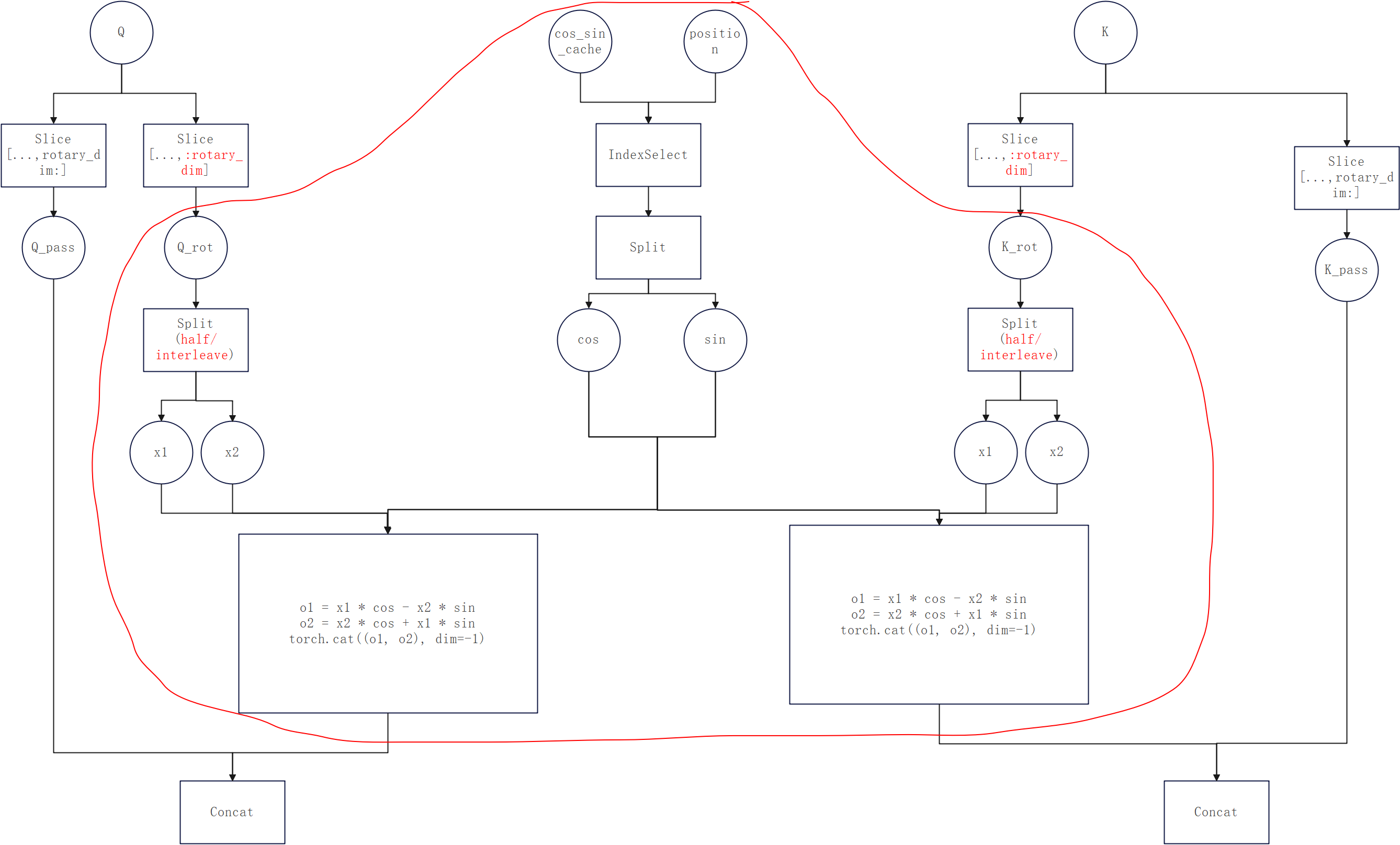
torch_npu._npu_rotary_embedding:现在vllm-ascend中默认使用的接口,调用ATB的RopeOperation,下图红线内的就是它的计算逻辑。
-
torch_npu.npu_mrope:调用aclnnRopeWithSinCosCache算子,同时支持rope和mrope,计算逻辑和_npu_rotary_embedding一致,因为做了select_index+rope融合,所以性能更好。
query, key = torch_npu.npu_mrope(
    positions,
    query,
    key,
    self.cos_sin_cache,
    self.head_size,
    mrope_section=[0,0,0], # 走rope时这里设为全0
    rotary_mode='half' if neox_style else 'interleave',
)
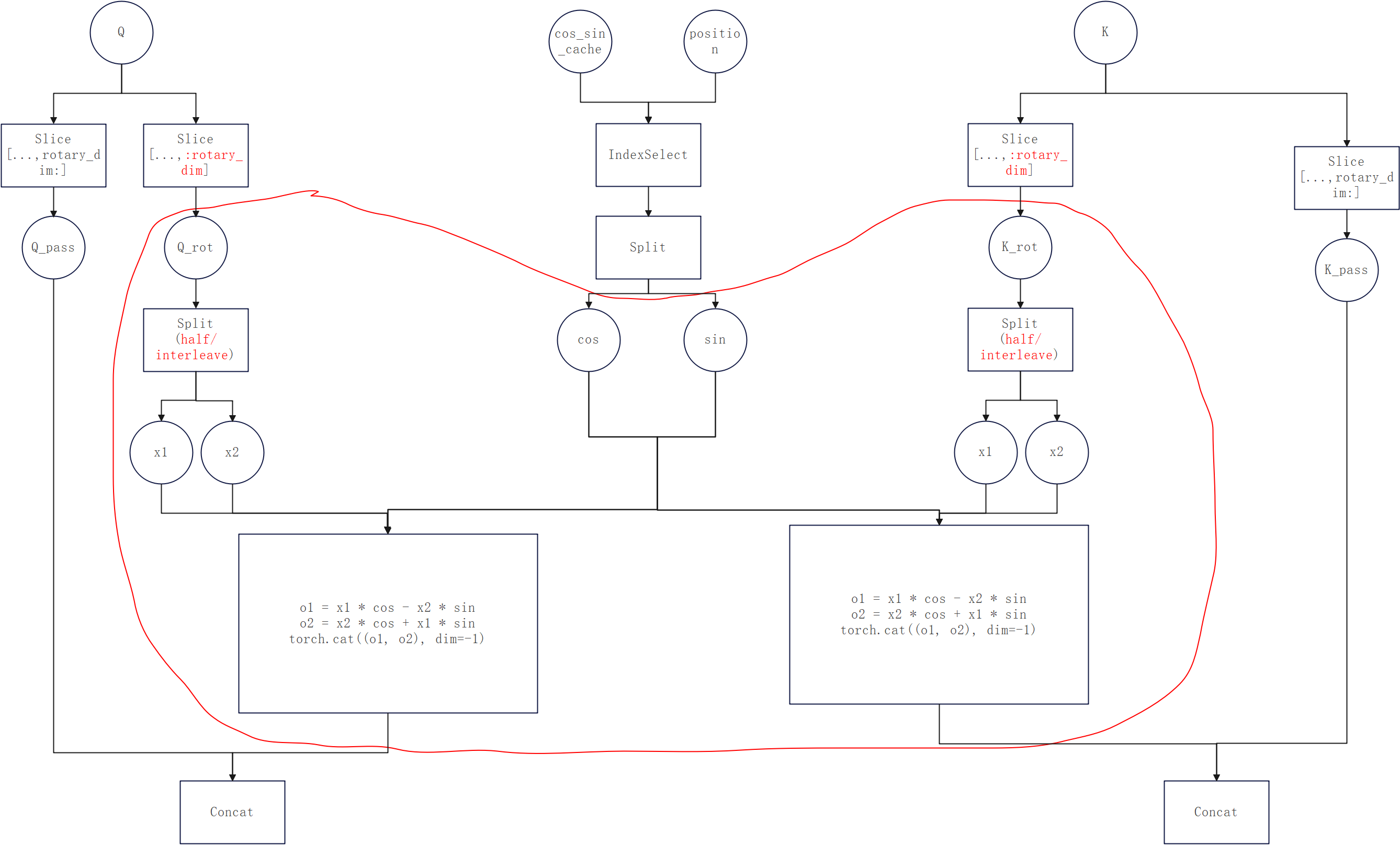
- torch_npu.npu_apply_rotary_pos_emb:调用aclnnApplyRotaryPosEmb算子,没有包含index_select部分,可以用来做cos和sin外置优化(参考链接:https://github.com/vllm-project/vllm-ascend/pull/1719),但是限制较多:
- 需要传入repeat后的cos和sin
- 只支持neox style
- 要求模型的head_size和rotary_dim都为128
- torch_npu.npu_interleave_rope:调用aclnnInterleaveRope算子,3中接口只支持neox style,那interleave模式可以尝试这个接口,参考文档:https://www.hiascend.com/document/detail/zh/Pytorch/710/apiref/torchnpuCustomsapi/context/torch_npu-npu_interleave_rope.md
- torch_npu.npu_rotary_mul:如下图,计算Q和K需要调两次这个接口,也能用来实现cos和sin外置,但性能如何暂未验证,参考文档:https://www.hiascend.com/document/detail/zh/Pytorch/710/apiref/torchnpuCustomsapi/context/torch_npu-npu_rotary_mul.md

昇腾计算产业是基于昇腾系列(HUAWEI Ascend)处理器和基础软件构建的全栈 AI计算基础设施、行业应用及服务,https://devpress.csdn.net/organization/setting/general/146749包括昇腾系列处理器、系列硬件、CANN、AI计算框架、应用使能、开发工具链、管理运维工具、行业应用及服务等全产业链
更多推荐

 17
17 0
0- 0


 已为社区贡献3条内容

所有评论(0)